In 1930, the average American over 15 years old drank three times the average American would drink in a year (which would be about 88 bottles of whiskey) as they would drink multiple times every day. The lives of women and children would be negatively affected by the inability for men to provide for them due to consuming so much alcohol. Many men would either experience a drop in their wages or would lose their jobs.
The political cartoon "The Drunkard's Progress" shows that many women and children were neglected and unsupported by their men (the drunkards.) (American Yawp)
The temperance movement began in the 1830s and 1840s when many sought for reform against alcohol. Abolitionists pushing for the end of slavery saw alcohol as unacceptable and sought to rid the world of it. The movement was mainly practiced by American Protestant churches, and first advised American men to drink in moderation. However, as time passed, the movement sought alcohol to be completely prohibited by the local, state, and national governments.
The Women's Christian Temperance Union (WCTU) was formed in 1870. Thousands of women (wives, mothers, etc.) were tired of the saloons that supplied millions of gallons of beer to men and protested politically for the cause of temperance. The WCTU had prominent leaders such as Susan B. Anthony, Elizabeth Cady Stanton, Frances Willard, and other women pushing for the ban on alcohol and also for the right to vote. By the late 1900's, the WCTU had achieved in creating an anti-alcohol educational campaign throughout the nation.
Carrie Nation, member of WCTU, would destroy bars using a hatchet. (Daily Mail)
A 1906 women's protest against alcohol in a parade for temperance in Kentucky. (PBS)
The Anti-Saloon League (ASL), founded in 1893, was the organization that had the most success in the prohibition of alcohol. Led by Wayne Wheeler, a temperance leader and lobbyist, the ASL was willing to form alliances with any group that shared the goal of pushing for a constitutional amendment that would ban the manufacture, transportation, and sale of alcohol. Wheeler had created a powerful organization, with the support of Democrats, Republicans, Progressives, the KKK, the NAACP, etc., in his campaign.
Men from the Anti-Saloon League in a rally for temperance. (PBS)
When America entered World War 1, ASL used it as leverage to issue propaganda which related alcohol with Germans and treason. By 1917, the eighteenth amendment was proposed and passed with ease through both houses of Congress. The amendment was ratified in 13 months and took effect on January 17, 1920. The prohibition of alcohol was then made official, yet many Americans would go on to defy this law.
Shoppers in Detroit purchasing alcohol one day before the prohibition came into effect. (Smithsonian)
“What Was the Temperance Movement?: Daily Bellringer.” YouTube, The Daily Bellringer, 28 Jan. 2024, youtu.be/DYYyGQhR5rI?si=1CbAP_KmPu7jUhPH.
BIBLIOGRAPHY
Schmidt, A. (2017, October 10). Carrie A. Nation used a hatchet to destroy bars during prohibition. Mail Online. https://www.dailymail.co.uk/news/article-4966510/Carrie-Nation-destroyed-bars-prohibition-hatchet.html
Okrent, D. (2010, May). Wayne B. Wheeler: The Man Who Turned Off the Taps. Smithsonian; Smithsonian.com. https://www.smithsonianmag.com/history/wayne-b-wheeler-the-man-who-turned-off-the-taps-14783512/
THE AMERICAN YAWP 10. Religion and Reform | THE AMERICAN YAWP. The American Yawp. https://www.americanyawp.com/text/10-religion-and-reform/
Burns, K. (2022). Roots of Prohibition | Prohibition | Ken Burns | PBS. Prohibition | Ken Burns | PBS. https://www.pbs.org/kenburns/prohibition/roots-of-prohibition
PBS. Women’s Temperance and the Anti-Saloon League | Prohibition. (n.d.). PBS LearningMedia. Retrieved April 27, 2024, from https://florida.pbslearningmedia.org/resource/womens-temperace-ken-burns-prohibition/womens-temperace-ken-burns-prohibition/
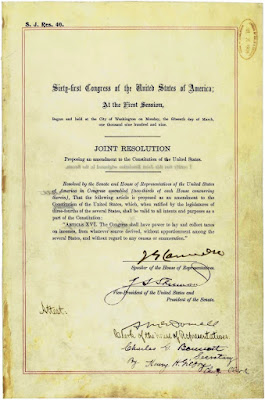
The Sixteenth Amendment in the Constitution of the United States. (Encyclopaedia Britannica) The Sixteenth Amendment of the Constitution was used to solve an issue relating to Sections 8 and 9 of Article I in the Constitution. Section 8 of Article I stated that the Constitution allows Congress to "lay and collect taxes, duties, imposts and excises, to pay the debts and provide for the common defence and general welfare of the United States; but all duties, imposts and excises shall be uniform throughout the United States." Section 9 stated that "No capitation, or other direct, tax shall be laid, unless in proportion to the census or enumeration herein before directed to be taken." Congress was unsuccessful in imposing taxes on income, as its attempts were struck down upon and faced with resistance. In a Supreme Court case, Pollock v. Farmers' Loan and Trust Company, the federal income tax was declared unconstitutional and removed par...
In the late nineteenth and early twentieth century, a trust was known as a cartel or monopoly involved in creating agreements to fully control a product or industry. Some of these monopolies are protected under the constitution, but these trusts in which one exercised full control over a product or industry were new to Americans. Rapid industrialization, along with advances in technology and urban growth influenced the structures of businesses. The laissez faire policy, enforced by the government, was very beneficial as it increased capital, increased labor supply, and helped the national market grow. However, many trusts emerged as businesses were unregulated, in which two of the most considerable trusts were those of Andrew Carnegie (Steel industry) and John Davison Rockefeller (Oil industry.) Similar to other trusts, these two men would employ horizontal (buying the competition) and vertical ( controlling every business process) integration strategies to further e...



Comments
Post a Comment