Upton Sinclair, publisher of The Jungle, was born on September 20, 1878, and died on November 25, 1968. (Time Toast)
Upton Sinclair was in an American writer for socialism, worker rights, health, etc. In 1904, Sinclair was sent by the Appeal to Reason magazine to look into the working conditions of the Chicago stockyards. Sinclair spend seven weeks investigating the stockyards and produced unsettling results. Sinclair then went on the write The Jungle, in which he intended to discuss mainly about the awful working conditions that the workers (immigrants) had to face. However, Sinclair also brought light to the terrible meatpacking practices that took place in the packinghouses (which is what the novel is more widely known for.) Some things that he exposed (and wrote about in vivid descriptions) about the meatpacking practices were of the contamination issues, sanitation issues, and overall uncleanliness while processing meat. The Jungle was published in 1905 (and became more popular in 1906 when it was revised and published as a book) and caused outrage amongst the public towards the poor quality and practices of the meat industry.
Images 1 & 2: The meat-packing industry was unsanitary, and the meat was inedible due to its contamination. (Let's Teach History)
Prior to the release of Upton Sinclair's novel, President Theodore Roosevelt had declared his support for federal food safety law. Sinclair and Roosevelt shared a similar goal regarding food safety, but Sinclair doubted that Roosevelt wanted to expose the meat industry. Roosevelt sent Charles Neill and James Reynolds to investigate the same stockyards that Sinclair had previously investigated. Both men discovered the same conditions that Sinclair had described in his novel (however their findings were not publicized.) It was not until Sinclair became impatient due to Roosevelt's inaction, and began leaking the investigators' findings, that Roosevelt did begin taking action. Roosevelt revealed eight pages of the investigators' report to the public, which further revolted the public.
A political cartoon of President Roosevelt taking care of the meat scandal. (Britannica)
On June 30th, 1906, Roosevelt signed the Meat Inspection Act and the Pure Food and Drug Act. The Meat Inspection Act set requirements for meat to be processed and shipped under sanitary conditions and banned the sale of adulterated and misbranded meat. The Pure Food and Drug Act prohibited the manufacture and sale of misbranded and adulterated meat and drugs in interstate commerce.
Source: American Experience. (2020, February 13). How “the jungle” changed American food | the poison squad | american experience | PBS. YouTube. https://www.youtube.com/watch?v=OuukM9OY-is&t=154s++%E2%80%8C
BIBLIOGRAPHY
Anderson, L. (2021, March 4). Video and Assignment Ideas for Upton Sinclair’s The Jungle. Let’s Teach History. https://letsteachhistory.com/video-and-assignment-ideas-covering-upton-sinclairs-the-jungle/
Roosevelt, T. Letter from Theodore Roosevelt to Upton Sinclair (1906). Teaching American History. https://teachingamericanhistory.org/document/to-upton-sinclair/
Klein, C. (2023, May 10). How Upton Sinclair’s “The Jungle” Led to US Food Safety Reforms. History; A&E Television Networks. https://www.history.com/news/upton-sinclair-the-jungle-us-food-safety-reforms
Petruzzello, M. (2019). Pure Food and Drug Act | United States [1906] | Britannica. In Encyclopædia Britannica. https://www.britannica.com/topic/Pure-Food-and-Drug-Act
Rouse, K. L. (2018). Meat Inspection Act of 1906 | History, Summary, & Facts. In Encyclopædia Britannica. https://www.britannica.com/topic/Meat-Inspection-Act
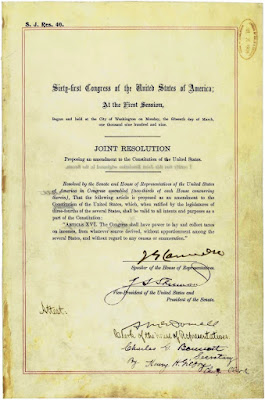
The Sixteenth Amendment in the Constitution of the United States. (Encyclopaedia Britannica) The Sixteenth Amendment of the Constitution was used to solve an issue relating to Sections 8 and 9 of Article I in the Constitution. Section 8 of Article I stated that the Constitution allows Congress to "lay and collect taxes, duties, imposts and excises, to pay the debts and provide for the common defence and general welfare of the United States; but all duties, imposts and excises shall be uniform throughout the United States." Section 9 stated that "No capitation, or other direct, tax shall be laid, unless in proportion to the census or enumeration herein before directed to be taken." Congress was unsuccessful in imposing taxes on income, as its attempts were struck down upon and faced with resistance. In a Supreme Court case, Pollock v. Farmers' Loan and Trust Company, the federal income tax was declared unconstitutional and removed par...
In the late nineteenth and early twentieth century, a trust was known as a cartel or monopoly involved in creating agreements to fully control a product or industry. Some of these monopolies are protected under the constitution, but these trusts in which one exercised full control over a product or industry were new to Americans. Rapid industrialization, along with advances in technology and urban growth influenced the structures of businesses. The laissez faire policy, enforced by the government, was very beneficial as it increased capital, increased labor supply, and helped the national market grow. However, many trusts emerged as businesses were unregulated, in which two of the most considerable trusts were those of Andrew Carnegie (Steel industry) and John Davison Rockefeller (Oil industry.) Similar to other trusts, these two men would employ horizontal (buying the competition) and vertical ( controlling every business process) integration strategies to further e...
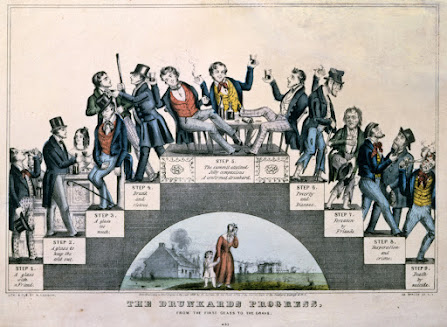
In 1930, t he average American over 15 years old drank three times the average American would drink in a year (which would be about 88 bottles of whiskey) as they would drink multiple times every day. The lives of women and children would be negatively affected by the inability for men to provide for them due to consuming so much alcohol. Many men would either experience a drop in their wages or would lose their jobs. The political cartoon "The Drunkard's Progress" shows that many women and children were neglected and unsupported by their men (the drunkards.) (American Yawp) The temperance movement began in the 1830s and 1840s when many sought for reform against alcohol. Abolitionists pushing for the end of slavery saw alcohol as unacceptable and sought to rid the world of it. The movement was mainly practiced by American Protestant churches, and first advised American men to drink in moderation. However, as time passed, the movement sought alcohol to be comp...



Comments
Post a Comment